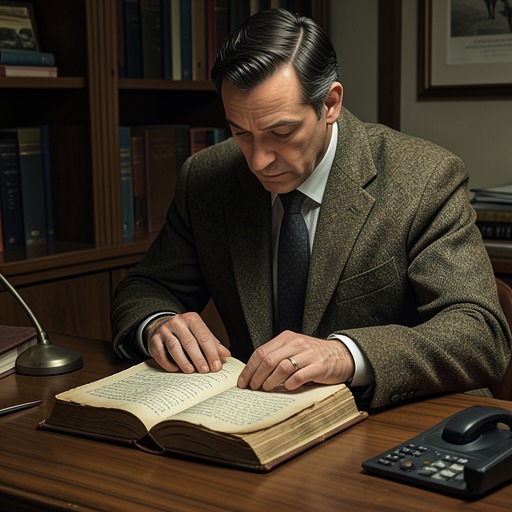
Richard’s Discovery of Wieder’s Hidden Manuscript
The Book of MirrorsRichard Flynn’s discovery of the hidden manuscript in Joseph Wieder’s library turns an ordinary task into a glimpse of a concealed text whose authorship and history remain uncertain. He finds it by accident, recognizes that it may be important, and hides his own discovery from Wieder. The physical concealment, the pages’ multiple hands, and Richard’s decision to put them back make the manuscript a material clue—but not an answer.
Circumstances and Discovery
In the days before the discovery, Richard was absorbed in the sudden change in his own life: some of his stories had been accepted for publication, and he was spending nearly every day at Wieder’s house. He worked for three or four hours at a time organizing the professor’s library, while his evenings belonged to Laura Baines. In retrospect, Richard noticed that Laura had grown distant and distracted, spoke to him less, and ended hushed telephone conversations when he entered the room. At the time, however, the change in his own prospects occupied him more.
The discovery begins with a practical need. Richard was looking for writing paper to diagram the final arrangement of shelves near the library door, where he had started his organizing work. Rather than go downstairs to fetch paper from Wieder’s desk, he opened a small cupboard at the bottom of the shelves opposite the door. It held a ream of paper, old magazines, and writing implements. Nothing about the cupboard initially announced that it contained anything more than supplies.
As Richard pulled out the paper, the sheets fell and scattered across the floor. While kneeling to collect them, he noticed that a pencil point seemed to be wedged into the wall where two sides of the cupboard should have joined. Moving the other objects aside, he found that the cupboard’s left side was a false wall. It opened onto a niche about the size of a phonebook, where a sheaf of papers lay inside a cardboard file. The dropped paper, rather than any deliberate search for a hidden compartment, had brought the concealed space to his attention.
The Manuscript’s Uncertain Identity
The file offered no clear identification. Its cover bore no inscription, and the pages contained no title page or author’s name. Richard could tell only that the work concerned psychiatry or psychology. The absence of identifying marks matters: although the discovery establishes that papers had been deliberately kept out of ordinary view, it does not establish who wrote them, when they were assembled, or what status they had.
The papers themselves appeared to contain more than one hand. Some were typewritten; others carried very small black-ink handwriting; still others were marked in large, left-leaning letters in blue ballpoint. Corrections covered both the typed and handwritten pages, and some pages had additional paragraphs attached with clear adhesive tape. The file therefore seemed less like a clean, finished volume than a working document with layers of alteration. Yet its visible complexity cannot, by itself, identify the contributors or explain why the papers were concealed.
Richard wondered whether it might be a draft of Wieder’s famous book, perhaps one of several drafts, or instead the manuscript of an older work that had already been published. He read the first couple of pages quickly, encountering scientific terminology unfamiliar to him, then returned the papers to the niche. His glance gave him enough to recognize the subject area but not enough to determine the text’s argument or provenance.
Concealment and Immediate Consequences
Richard took care to arrange the objects more or less as he had found them. He did not want Wieder to realize that he had discovered the hiding place or rummaged through the house. The episode thus produces no confrontation and no immediate disclosure: Richard leaves the concealed material where it was and carries away an unresolved suspicion. His choice preserves the secret while making him, privately, a witness to its existence.
That restraint also limits what the discovery can establish. Richard has found a hidden file, not proof that it is the particular book he suspects, and he has not secured or studied it. The mismatch between the apparent importance of the papers and the cursory nature of his examination becomes central to the event: the manuscript is physically present, yet its identity remains as inaccessible as the compartment that held it.
Later Documentary Context
The manuscript’s uncertain status gains significance when Richard’s later investigation turns to the publisher’s records. An editor tells him that Wieder submitted a book proposal in July 1987 with the first chapter enclosed, stating that the manuscript was complete and ready for submission. A contract followed in August, and Wieder was expected to revise the text with his editor in November. He requested more time to polish it over the holidays, but the full manuscript never reached the publisher before tragedy intervened.
Those records establish a documentary gap, not an identification of the pages Richard found in the cupboard. They confirm that Wieder had proposed a completed book and that its full text did not arrive at the publisher; they do not say whether the hidden file was that book, an earlier draft, or another work. Richard’s investigation consequently becomes harder rather than simpler. He describes himself as lost in a maze of contradictory details, with Wieder’s public stature increasingly eclipsing Richard Flynn’s missing book as the apparent center of the inquiry. The discovery supplies a tangible object around which questions can gather, but neither the object nor the later archival account closes the gap.
Narrative Significance
The scene makes the hidden manuscript an emblem of the distinction between finding evidence and understanding it. Its secret compartment gives the papers a clear history of concealment, while their absent title, absent author, and visibly revised pages resist a clear account of their meaning. Richard’s investigation repeatedly encounters partial records—a file in a cupboard, a proposal in a publisher’s archive, and a full manuscript that never arrived—and must not mistake one surviving fragment for a complete explanation.
The event also introduces a pattern of retrospective uncertainty. Richard later recognizes signs of change in Laura that he failed to register at the time; similarly, he discovers the papers but cannot interpret what he has found. In both cases, the facts become legible only in retrospect, and even then they do not necessarily resolve into a single coherent story. The hidden manuscript therefore advances the mystery while sharpening its governing problem: evidence can be real, concrete, and carefully preserved, yet remain insufficient to establish the truth it seems to promise.